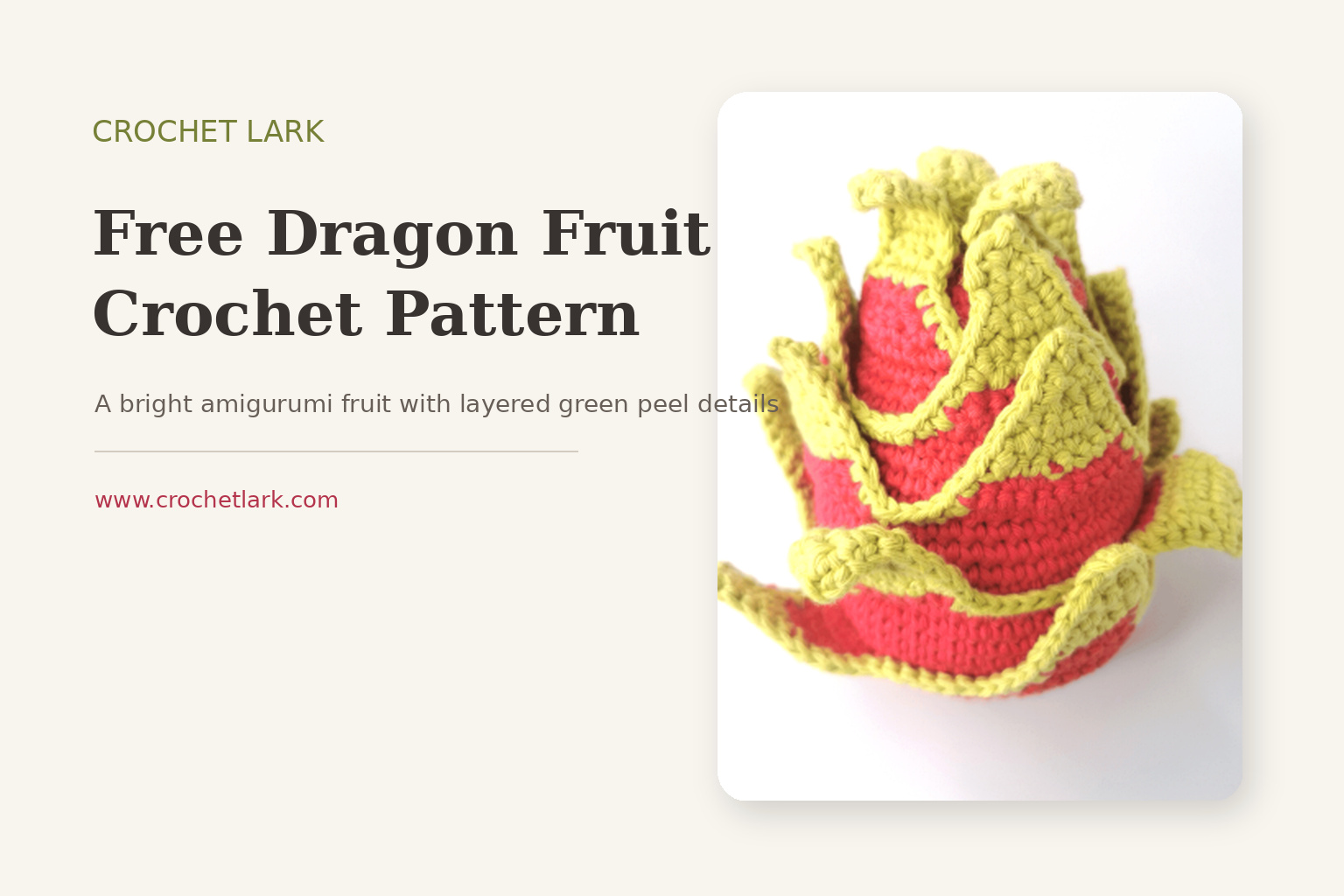
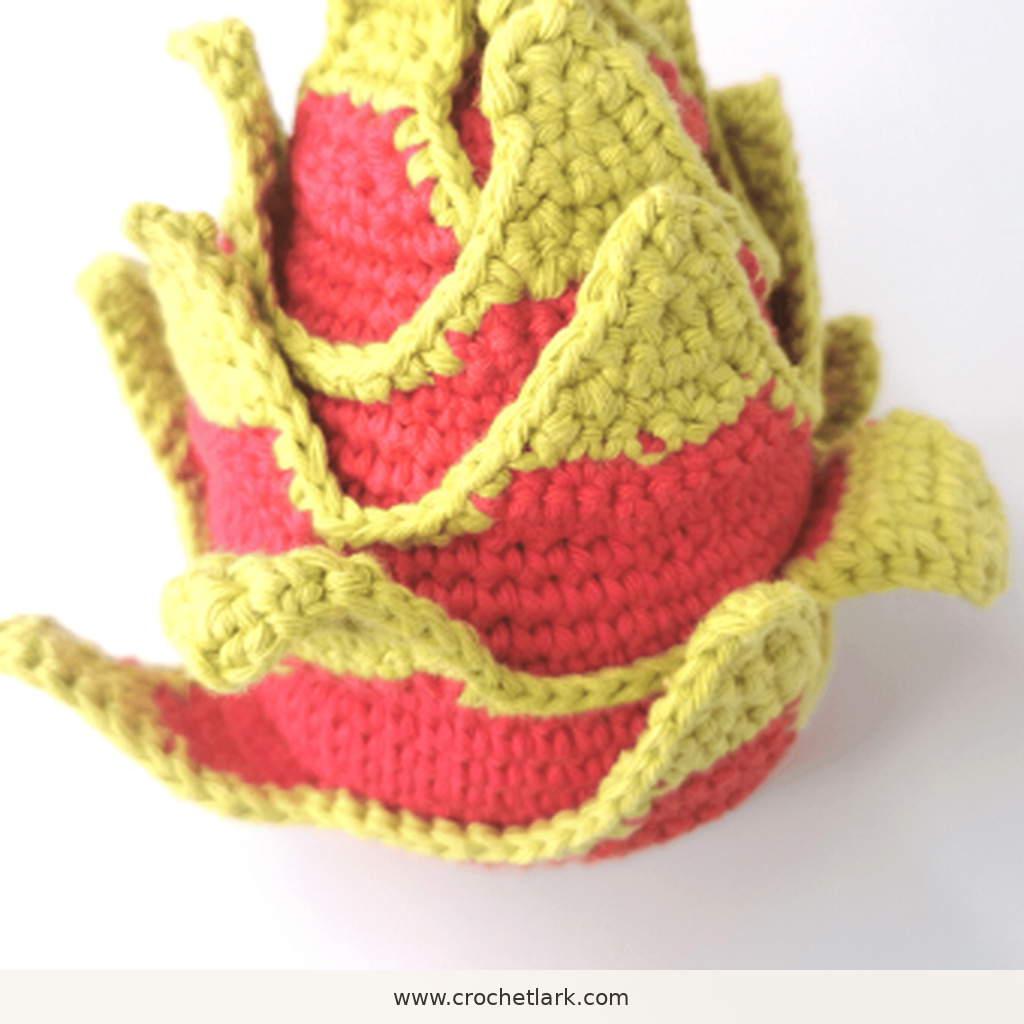
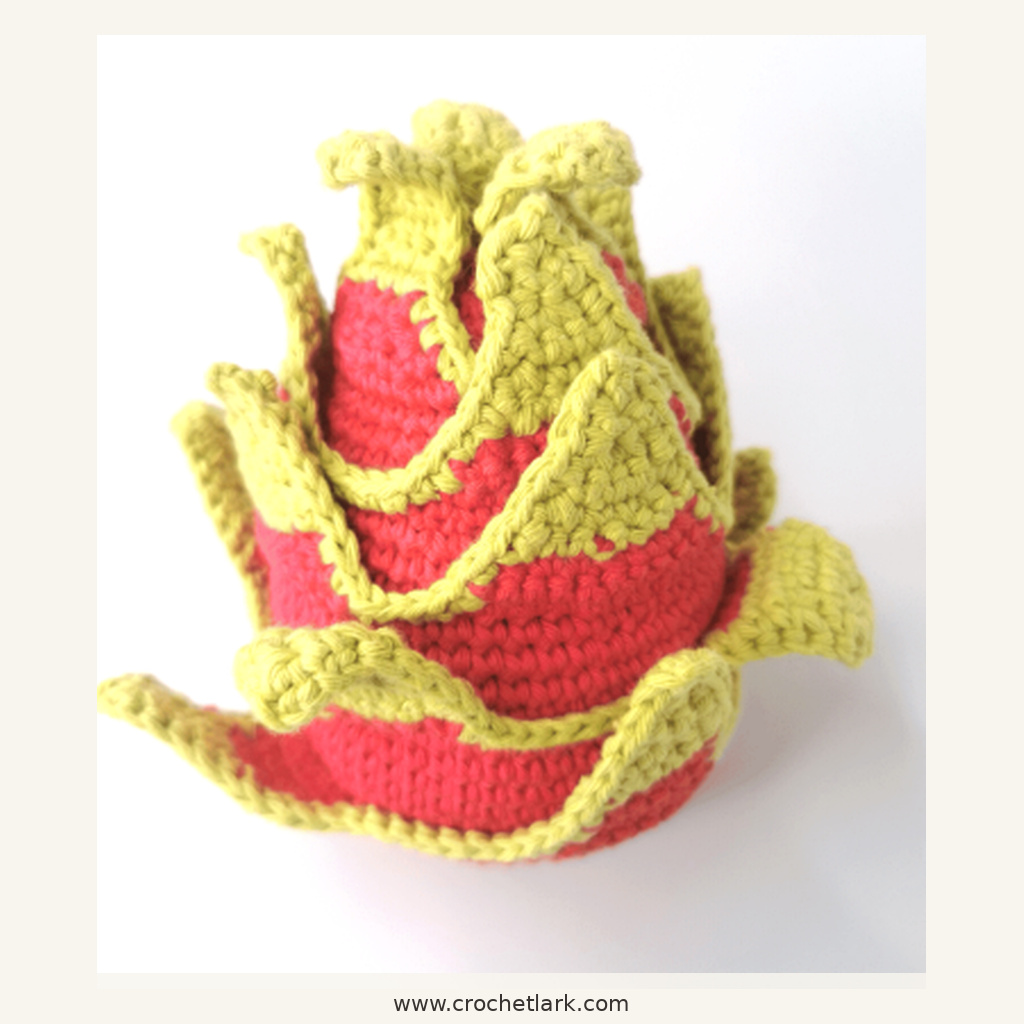
This crochet dragon fruit is a colorful amigurumi project with a rounded bright-pink body and layers of green-tipped peel. The unusual construction makes it especially eye-catching as part of a crochet fruit collection, play-food set, or handmade display.
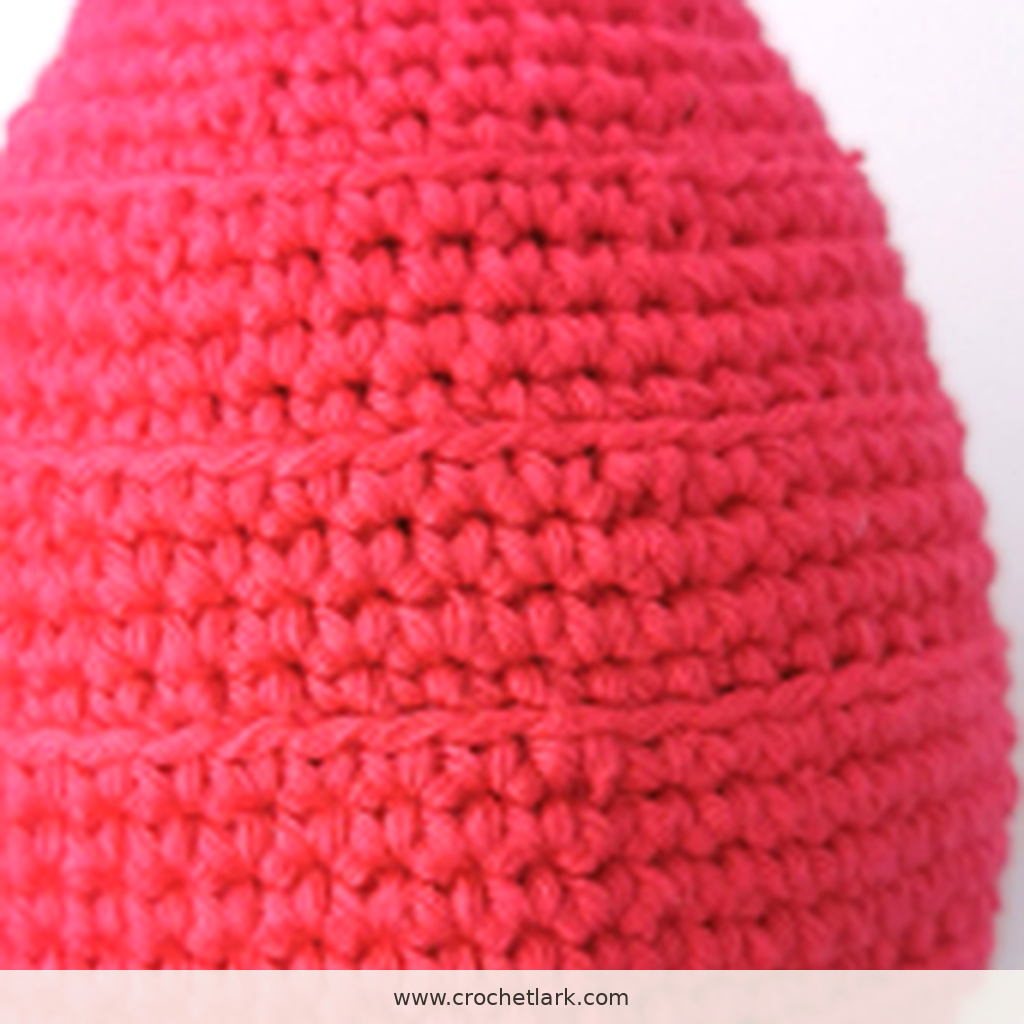
The body is crocheted first, with selected rounds worked through the back loops. Those exposed front loops are then used to attach the decorative peel sections around the fruit.
This Crochet Lark version is published within the permission confirmed for this project. I have not claimed that Crochet Lark originally designed or independently tested the pattern.
Quick Answer
The dragon fruit uses Aran/worsted-weight yarn in pink and green with a 4 mm crochet hook. The body is worked in continuous rounds and stuffed before closing. Five groups of pointed peel sections are then crocheted directly into the exposed front loops of the body. The source does not provide a finished measurement or require a formal gauge swatch.
Why You’ll Love This Project
- Distinctive layered dragon-fruit shape
- Bright two-color design
- No separate sewing required for the peel bands
- Uses familiar amigurumi increases and decreases
- A fun addition to crochet fruit or pretend-food collections
Materials
You will need:
- Aran/worsted-weight yarn in pink — Color A
- Aran/worsted-weight yarn in green — Color B
- 4 mm crochet hook
- Stuffing
- Scissors
- Tapestry needle
- Stitch marker
The source recommends choosing a hook small enough to create dense fabric so the stuffing does not show between stitches.
Finished Size
A finished measurement is not provided in the verified source, so no finished dimensions have been added.
Your final size will vary according to yarn, tension, stuffing, and hook choice.
Gauge
A formal gauge swatch is not required.
For amigurumi, maintain firm, even tension so the stuffing remains hidden between the stitches.
Abbreviations
- R – Row or round
- st / sts – Stitch / stitches
- ch – Chain
- sl st – Slip stitch
- mc – Magic circle
- sc – Single crochet
- inc – Increase
- dec – Decrease
- BLO – Back loop only
- FLO – Front loop only
- sk – Skip
- FO – Fasten off
Numbers in parentheses show the stitch count at the end of the row or round.
Before You Begin
Work the pink body in continuous rounds and use a stitch marker to identify the beginning of each round.
Several body rounds are deliberately worked in the BLO. This leaves the front loops free so the five peel bands can be attached later.
The individual pointed peel sections are worked back and forth in rows. Turning chains do not count as stitches. The original instructions also recommend invisible decreases where practical.
Important Source Consistency Note
The source contains several internal row-reference inconsistencies that should not be silently changed:
- Peel 2, Peel 3, Peel 4, and Peel 5 later say to repeat the spike instructions “to R11,” although their local spike sequences end earlier.
- Peel 4 is attached to the FLO of base R17, but its final border instruction refers to R21.
Below, “repeat the spike sequence” means repeating that peel’s complete local sequence. The Peel 4 R17/R21 conflict remains explicitly flagged rather than being presented as a verified correction.
Crochet Instructions
Dragon Fruit Base
Use Color A — pink. Work continuously from the bottom upward.
Reading key: commas indicate consecutive stitches; semicolons separate rounds.
R1=mc,6sc(6);R2=inc×6(12);R3=[sc,inc]×6(18);R4=[2sc,inc]×6(24);R5=[3sc,inc]×6(30).

R6=[4sc,inc]×6(36);R7=[5sc,inc]×6(42);R8=[6sc,inc]×6(48);R9=[7sc,inc]×6(54);R10=[8sc,inc]×6(60).

R11=sc×60;R12=BLO-sc×60;R13-15=sc×60;R16=[8sc,dec]×6(54);R17=BLO-sc×54.

R18-19=sc×54;R20=[7sc,dec]×6(48);R21=BLO-sc×48;R22-23=sc×48;R24=[6sc,dec]×6(42).

R25=BLO-sc×42;R26=[5sc,dec]×6(36);R27=sc×36;R28=[4sc,dec]×6(30);R29=BLO-sc×30.

R30=sc×30;R31=[3sc,dec]×6(24);STUFF;R32=[2sc,dec]×6(18);R33=[sc,dec]×6(12);R34=dec×6(6);FO-15cm;thread-tail-through-last-6-FLO;pull-closed;bury-tail.
The body sequence and stitch counts above follow the verified source instructions.
Dragon Fruit Peel
The fruit has five peel bands. Each band consists of three or four pointed sections, followed by a border worked around the points and through the appropriate exposed front loops of the body.
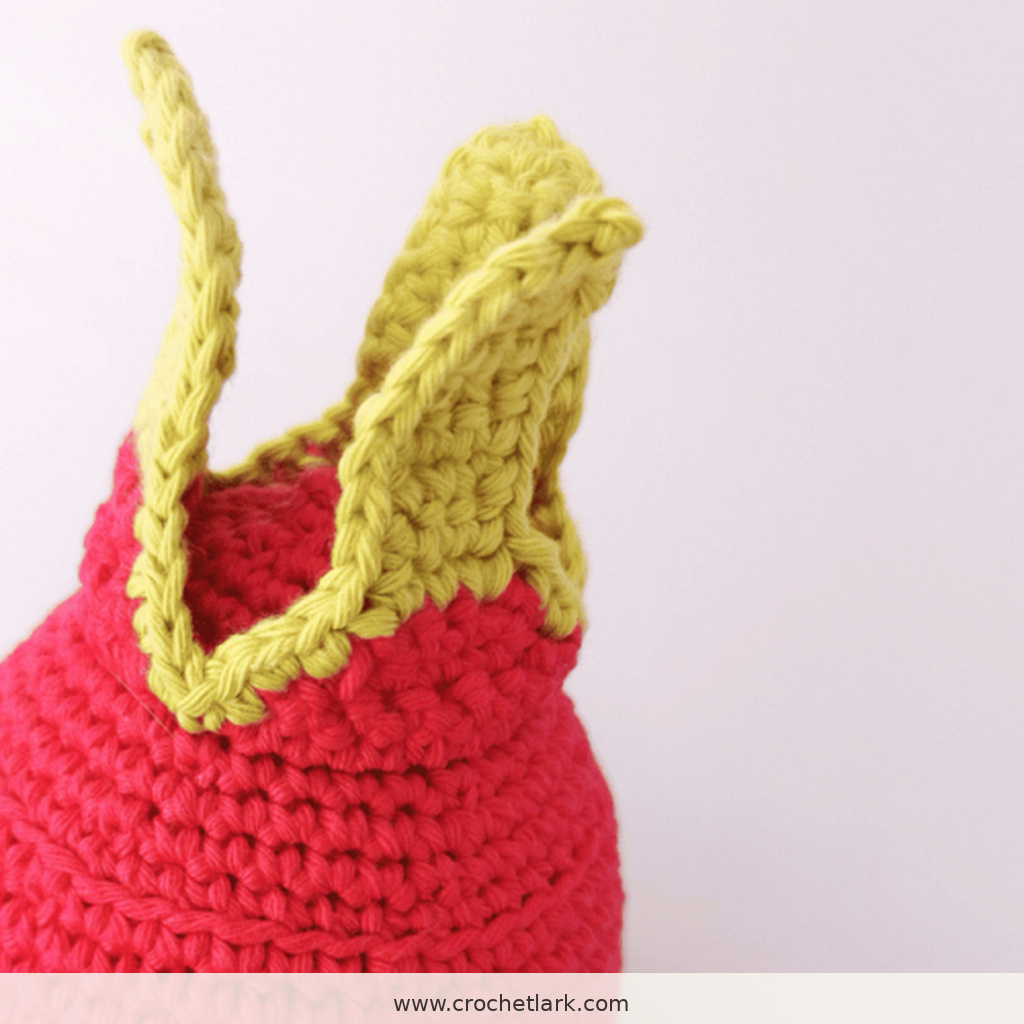
Peel 1 — Base Round 29 FLO
Attach Color A to any exposed FLO from body R29.
P1.R1=10sc,ch1,turn(10);R2=[sc,dec]×3,sc,ch1,turn(7);R3=dec,3sc,dec,ch1,turn(5);R4=dec,sc,dec(3);change-B.

P1.R5-8=3sc,ch1,turn(3);R9=dec,sc,ch1,turn(2);R10=2sc,ch1,turn(2);R11=dec(1);FO.

P1.Spike2=same,next-R29-FLO;Spike3=same,keep-yarn.

P1.R12=[ch1,11sc-down,11sc-up-next,ch1,sc-tip,ch2,sc-same-tip]×3,ch1,slst-first-sc(72);FO.
Weave in the ends after completing the border.
Peel 2 — Base Round 25 FLO
Attach Color A to an exposed FLO from body R25.
P2.R1=10sc,ch1,turn(10);R2=dec,6sc,dec,ch1,turn(8);R3=dec,4sc,dec(6);change-B.

P2.R4=2sc,dec,2sc,ch1,turn(5);R5=dec,sc,dec,ch1,turn(3);R6=3sc,ch1,turn(3);R7=dec,sc,ch1,turn(2);R8=dec(1);FO.

P2.Spikes=3-total;skip4-base-FLO-between-starts;keep-yarn-after-spike3.[Source-later-says-to-R11;local-sequence-ends-R8.]

P2.R9=[ch1,8sc-down,4sc-R25-FLO,8sc-up-next,ch1,sc-tip,ch2,sc-same-tip]×3,ch1,slst-first-sc(66);FO.
Peel 3 — Base Round 21 FLO
P3.R1-2=10sc,ch1,turn(10);R3=[dec,2sc]×2,dec(7);change-B.

P3.R4=2sc,dec,3sc,ch1,turn(6);R5=dec,2sc,dec,ch1,turn(4);R6=4sc,ch1,turn(4);R7=dec×2,ch1,turn(2);R8=dec(1);FO.

P3.Spikes=4-total;skip2-base-FLO-between-starts;keep-yarn-after-spike4.[Source-later-says-to-R11;local-sequence-ends-R8.]

P3.R9=[ch1,8sc-down,2sc-R21-FLO,8sc-up-next,ch1,sc-tip,ch2,sc-same-tip]×4,ch1,slst-first-sc(80);FO.
Peel 4 — Base Round 17 FLO
P4.R1=6sc,ch1,turn(6);R2=6sc(6);change-B.

P4.R3-4=6sc,ch1,turn(6);R5=dec,2sc,dec,ch1,turn(4);R6=4sc,ch1,turn(4);R7=dec×2,ch1,turn(2);R8=dec(1);FO.

P4.Spikes=4-total;skip7-before-spike2;skip8-before-spike3;skip8-before-spike4;keep-yarn.[Source-later-says-to-R11;local-sequence-ends-R8.]

P4.R9=[ch1,8sc-down,7sc-base-FLO,8sc-up-next,ch1,sc-tip,ch2,sc-same-tip]×2;[ch1,8sc-down,8sc-base-FLO,8sc-up-next,ch1,sc-tip,ch2,sc-same-tip]×2;ch1;slst-first-sc(102);FO.

P4.CONFLICT=source-labels-border-base-FLO-as-R21;peel-starts-at-R17;verify-before-working-border.
Do not silently substitute R17 for R21. The construction suggests an internal source mismatch, but the available source does not independently verify the correction.
Peel 5 — Base Round 12 FLO
P5.R1-2=8sc,ch1,turn(8);R3=dec,4sc,dec,ch1,turn(6);R4=6sc,ch1,turn(6);R5=dec,2sc,dec(4);change-B.

P5.R6=4sc,ch1,turn(4);R7=dec×2,ch1,turn(2);R8=2sc,ch1,turn(2);R9=dec(1);FO.

P5.Spikes=4-total;skip7-base-FLO-between-starts;keep-yarn-after-spike4.[Source-later-says-to-R11;local-sequence-ends-R9.]

P5.R10=[ch1,9sc-down,7sc-R12-FLO,9sc-up-next,ch1,sc-tip,ch2,sc-same-tip]×4,ch1,slst-first-sc(108);FO.
Assembly
There is no separate sewing assembly for the peel bands. Each one is crocheted directly onto the exposed front loops left on the body.
Once all five bands are complete, weave in every pink and green yarn tail securely.
Finishing
Gently arrange the green points so the layers open outward around the pink fruit rather than lying completely flat.
Check the stuffing distribution and lightly shape the body by hand if necessary.
Helpful Notes
- Keep the stitch marker in the first stitch throughout the body.
- Do not accidentally crochet through both loops on R12, R17, R21, R25, or R29.
- Keep the body fabric dense enough to conceal the stuffing.
- When changing from pink to green on a peel point, begin the green section from the specified final pink stitch.
- Check stitch counts before beginning each peel border.
- The unresolved Peel 4 R17/R21 reference remains a source inconsistency; verify that specific border against the licensed original if possible.
FAQ
Is this dragon fruit worked in one piece?
The pink body is one stuffed piece. The peel bands are subsequently crocheted directly onto the body rather than sewn on as completely separate pieces.
Do I need to match gauge?
No formal gauge is supplied. Firm amigurumi tension is more important so the stuffing remains hidden.
Can I use a different yarn weight?
You can, but it will change the finished size. Adjust the hook accordingly and keep the fabric sufficiently tight.
Why are some body rounds worked BLO?
Those rounds leave exposed front loops. The peel bands later attach to those FLO.
Why is Peel 4 marked with a warning?
The source attaches Peel 4 at body R17, but the final border text refers to R21. Because those two references conflict, the discrepancy is clearly preserved rather than silently altered.
Final Thoughts
The layered peel construction is what makes this dragon fruit stand out from simpler crochet fruit patterns. Once the pink body is finished, the progressively larger peel bands transform it into the recognizable finished shape shown in the reference photographs.
The only technical item that still requires caution is the explicitly flagged Peel 4 row-reference conflict.